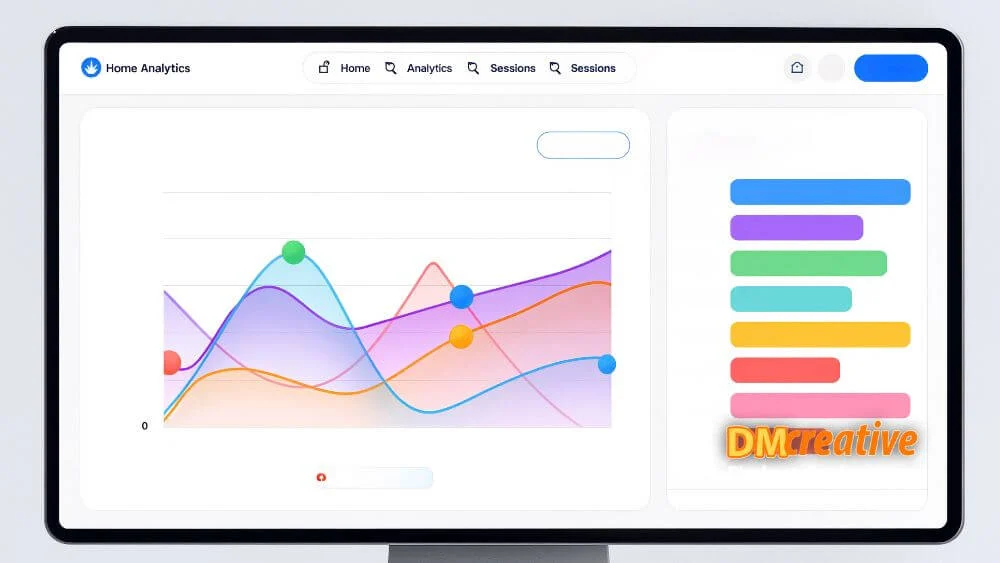
Website trends 2025 are no longer simply about new colors, typography, animations, or visual effects. The most important change is happening beneath the surface: the website is becoming less of a static digital presentation and more of an integral part of a company’s business infrastructure.
Marketing, sales, content, analytics, CRM platforms, automation, customer support, and artificial intelligence increasingly meet in the same digital environment. As a result, the key question is no longer simply, “Does the website look modern?” It is also: Does it perform well? Is it fast and accessible? Can it communicate with other systems? Can users quickly complete what they came to do? And does the website create measurable business value?
From digital brochure to business platform
For years, many businesses treated their website as a digital brochure: a homepage, several service pages, a contact form, and perhaps a blog. That structure can still be perfectly appropriate for some smaller projects, but growing companies increasingly expect much more from their digital presence.
A modern website can receive quotation requests, qualify leads, exchange information with a CRM, trigger marketing automation, connect e-commerce with ERP systems, work with booking platforms and external APIs, and deliver more relevant experiences to different users.
This changes the logic of web development itself. Design remains important, but it should increasingly follow business objectives and user journeys rather than determine them.
Performance is an architectural decision
Website speed should no longer be reduced to a simplistic rule that “a page must load in under two seconds.” Google uses a more precise framework through Core Web Vitals, which measure loading performance, interactivity, and visual stability in real user conditions.
Google’s recommended thresholds for a good user experience are a Largest Contentful Paint (LCP) of 2.5 seconds or less, an Interaction to Next Paint (INP) of 200 milliseconds or less, and a Cumulative Layout Shift (CLS) score of 0.1 or less, evaluated at the 75th percentile of page visits.
Performance, however, does not begin when development is finished. It begins with architecture: hosting, the choice of CMS or framework, DOM complexity, JavaScript weight, font loading, image optimization, caching, CDN configuration, and the number of third-party scripts.
A sophisticated visual experience has limited value if the interface responds slowly or makes users wait for essential information.
AI is moving beyond the traditional chatbot
The first visible wave of website AI integration was dominated by chatbot widgets. In 2025, the opportunity is becoming considerably broader.
According to Figma’s 2025 AI Report, based on research involving 2,500 product builders across seven countries, 51% of respondents working on AI products were building agents, compared with 21% the previous year. It is a useful indication of where digital product development is heading.
An AI agent does not have to stop after answering a single question. In a properly designed system, it can search an approved knowledge base, ask follow-up questions, guide a visitor toward the right service, assist with product selection, or activate the next step in a sales or support workflow.
That does not mean every website needs AI. The technology creates value only when it solves a real problem. A generic chatbot with little understanding of the company’s products or services can easily create more friction than value.
SEO is entering the AI Search era
The website itself is not the only thing changing. The way users discover websites is changing as well.
In May 2025, Google published official guidance for website owners on performing well in AI Overviews and AI Mode. One of the most important aspects of that guidance is that Google did not introduce an entirely separate form of “AI SEO.” The same foundations continue to matter: unique and useful content, a strong page experience, technically accessible and indexable pages, and structured data that accurately represents visible page content.
SEO therefore cannot be reduced to repeating keywords throughout a page. Content needs to answer real questions clearly, demonstrate genuine knowledge of the subject, and provide something beyond a rewritten version of information already available elsewhere.
For businesses, this is another reason to treat expert content and blogging as long-term digital assets rather than boxes to tick on a marketing checklist.
Accessibility is becoming a core web requirement
Accessibility should no longer be treated as an optional feature reserved for specialist projects.
The European Accessibility Act began applying from 28 June 2025 to several categories of products and services in the European Union, including e-commerce. At the same time, WCAG 2.2 provides established guidelines and testable criteria for making web content more accessible to people with different disabilities.
In practical web design, this means better contrast, logical heading structures, keyboard accessibility, correctly labelled forms, meaningful alternative text, sufficiently large interactive targets, and interfaces that do not rely exclusively on color or visual effects to communicate meaning.
Good accessibility frequently improves usability for everyone, not only users with disabilities. Clearer interfaces, predictable navigation, and understandable content generally make digital products easier to use.
Micro-interactions are becoming more purposeful
Animation is not disappearing, but its role is becoming more mature. Instead of moving every available element simply because the technology allows it, modern UX increasingly uses micro-interactions to communicate state and feedback: a button has been activated, a form has been submitted, an item has changed state, or navigation is moving toward new content.
In October 2025, the Chrome team published an updated overview of the View Transition API, reflecting the continued development of smoother transitions between interface states and pages without requiring unnecessarily heavy custom implementations.
The principle remains simple: motion should help users understand what is happening, not merely demonstrate how much can be animated.
API-first architecture connects the website to a wider ecosystem
Headless and API-first architectures remain an important direction in web development, but they are not automatically the right solution for every project.
For organizations operating across several channels – websites, mobile applications, e-commerce systems, client portals, internal applications, and external services – separating the content and presentation layers can provide significant flexibility. The same content or data can be delivered across multiple digital touchpoints.
A straightforward corporate website, however, does not need to become a complex headless stack simply because the technology is fashionable. Architecture should reflect real operational requirements, budget, technical capacity, and the expected development of the business.
Specific experience is becoming more valuable than generic content
As the web fills with increasingly generic content, specificity becomes a competitive advantage.
First-hand experience, actual projects, local market context, proprietary data, detailed examples, and a clear professional perspective can provide significantly more value than another broad article built around a popular keyword.
Google’s 2025 AI Search guidance explicitly emphasizes unique and valuable content designed to satisfy people’s needs. For businesses, the implication is important: you do not necessarily need to publish more than everyone else. You need to publish content in areas where you have a legitimate reason to be useful and authoritative.
The trend connecting all the others
Performance, AI, accessibility, SEO, micro-interactions, and API integrations can easily look like another collection of independent technology trends.
Viewed together, however, they point toward one larger change: the website is moving beyond its role as an isolated marketing asset and becoming an active part of how the business operates.
That is why a modern web project should begin with questions about the business, the user, and the underlying processes before moving to visual decisions. What does the visitor need to accomplish? Which systems need to exchange information? What should be measured? Which tasks can be automated? And what content genuinely helps a potential customer make a decision?
The most modern website is not the one with the largest number of effects. It is the one that quietly connects technology, content, user experience, and business strategy into a coherent and useful digital system.