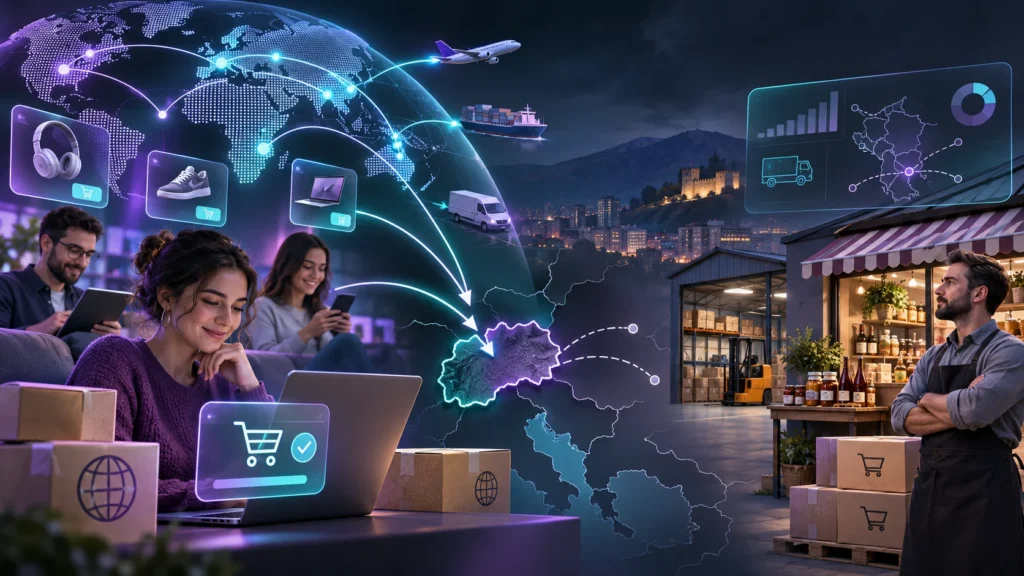
North Macedonia’s e-commerce market is growing. Its ability to turn digital commerce into a scalable export channel is another matter. Macedonian consumers routinely shop from international merchants, while many local companies still design their online sales operations around the limits of a small domestic market. After more than a decade of digitalisation initiatives, it is time to ask a less comfortable question: what would it take for Macedonian businesses to become serious cross-border sellers?
The 9th Regional E-commerce Conference, held in Skopje on 3 November 2026, brought together speakers, platforms, payment providers and businesses from across the region. Artificial intelligence, digital payments and the next generation of online commerce were prominent themes. The event gave the industry another opportunity to discuss where commerce is heading.
It also provides a timely reason to challenge how we define progress at home. Are we building internationally competitive sellers, or primarily improving the conditions for international sellers to reach Macedonian customers?
Both can happen at once. Increased online spending is welcome, but transaction volume alone tells us little about the international competitiveness of domestic businesses. The more consequential questions concern who is capturing demand, how far local brands can reach and whether their operating models can support profitable sales beyond national borders.
E-commerce is growing. The direction of spending deserves closer attention.
According to the E-commerce Association of North Macedonia’s analysis of National Bank data, online payment-card transactions reached approximately €950 million in 2025, up 32% on 2024.
That headline conceals a significant difference between the various flows. Cards issued in North Macedonia generated approximately €470 million in transactions with domestic e-merchants. Foreign-issued cards accounted for a further €52 million at domestic e-merchants. Meanwhile, cards issued in North Macedonia generated approximately €428 million in transactions with foreign e-merchants.
The first half of 2026 offers more recent evidence. The association’s October 2026 analysis reports €530.3 million in total online transactions for January–June 2026. Of this amount, Macedonian-issued cards accounted for €227.9 million at foreign merchants, while foreign-issued cards generated €30.9 million at Macedonian merchants. The total value of transactions at domestic e-merchants, involving both domestic and foreign-issued cards, was €302.4 million.
These figures require careful interpretation. Spending with foreign merchants is not equivalent to merchandise imports, and foreign-card spending at Macedonian merchants is not a direct measure of exports. The statistics also include services, subscriptions, bookings and other payments. A card’s country of issue does not establish the buyer’s residence or the destination of a physical product. It would therefore be misleading to calculate an “e-commerce trade deficit” by simply subtracting the two categories.
Even with those limitations, the commercial asymmetry is worth examining. Consumers in North Macedonia have made international online purchasing part of ordinary life. A much smaller proportion of domestic businesses appear to be systematically using digital channels to pursue customers abroad.
A domestic store is a sensible starting point. It should not automatically be the finish line.
Consider a clothing manufacturer with its own brand, a retail outlet and a functioning WooCommerce store. The catalogue is well organised, customers can pay, and delivery covers Skopje, Bitola, Ohrid and Tetovo. For the company, that is meaningful progress: it has made an existing sales operation more accessible and easier to manage.
Now suppose the manufacturer has spare production capacity and products that could appeal to customers in Belgrade, Zagreb, Ljubljana or Vienna. Has anyone assessed those markets, tested demand and calculated the delivered cost? Or did the original website brief quietly assume that the business would never sell beyond North Macedonia?
Not every product is suitable for direct international shipping. Low-value, bulky, fragile or heavily regulated goods may be uneconomic to sell that way. Many local service providers have no reason to target foreign consumers. The domestic market remains essential, and sometimes it is the most profitable market available.
But a manufacturer, specialist brand, digital publisher or software company should make that decision through analysis. When a business with export potential designs its entire digital operation for a national audience without evaluating alternatives, it places a ceiling on growth before the market has been tested.
For a small economy, domestic e-commerce should often serve as a proving ground for a wider commercial ambition. It can validate products, customer support, payments and order handling. What it should not do is quietly become the only market the business ever considers.
The problem often begins with: “How much does an online shop cost?”
It is a reasonable procurement question. It is also a poor starting point for a serious commercial investment.
Before choosing a platform or requesting a design quotation, a company needs to know which buyers it intends to serve, the markets it can reach, its average order value, gross margin, product constraints and preferred sales channels. Payment availability, shipping costs, inventory ownership and returns handling can materially change the technology specification.
Imagine building a storefront around Macedonian denar prices and domestic delivery, then deciding a year later to sell in three additional countries. The company may need to revisit its catalogue structure, language versions, checkout logic, tax settings, order notifications, stock records and integrations with logistics partners. Retrofitting those components is usually more expensive and disruptive than planning a sensible extension path from the outset.
This is why we approach e-commerce development at DMCreative.pro through the sales model first. WordPress, WooCommerce, design and automation are implementation choices. Their value depends on whether they support the commercial process the company is actually trying to run.
A visually polished storefront cannot compensate for the wrong market, an uncompetitive delivery proposition or an order that loses money.
What the Western Balkans reveal: digital activity is not the same as export readiness.
The challenge extends beyond North Macedonia. The Western Balkan Ecommerce Report 2025 examines Albania, Bosnia and Herzegovina, Kosovo, Montenegro, North Macedonia and Serbia. It documents growth in digital commerce alongside persistent differences in consumer trust, online payments and infrastructure across the region.
Regional marketplaces and distribution networks demonstrate that commercial operations do not have to end at a national border. For some manufacturers and retailers, a combination of their own storefront, marketplace access and distribution partners may be more viable than a single direct-to-consumer channel. Each option brings trade-offs. Marketplaces provide potential access to buyers, but commissions, platform rules, customer-data restrictions and dependence on external algorithms need to enter the calculation.
North Macedonia’s international ambitions remain modest relative to the opportunity. The OECD’s SME Policy Index 2026 reports that only about 12% of surveyed SMEs use digital tools to reach global markets. Around 41% use them to increase domestic sales.
Among the surveyed SMEs engaged in online selling, 65% used their own websites and 53% used social media; none of the respondents reported using third-party marketplaces for online sales. These are survey findings rather than a census of all Macedonian companies, and they should not be presented as universal market shares. They nevertheless point to a pattern: digital tools are being adopted, but they are seldom treated as instruments for deliberate international expansion.
That is a strategic problem, not merely a technology gap. Businesses need the capabilities to identify opportunities beyond the domestic market, make financially credible offers and operate the sales channels that can deliver them.
After years of digitalisation programmes, where is the export infrastructure?
North Macedonia has introduced regulatory changes, developed digital services and promoted business digitalisation for years. These efforts have produced real improvements. But a small, open economy needs to evaluate progress against actual commercial outcomes, not conference attendance, training sessions or the number of websites launched.
The OECD’s 2026 assessment is particularly revealing. North Macedonia’s score for promoting the use of e-commerce fell from 3.33 in 2022 to 3.04 in 2026. That is a specific public-policy assessment, not proof that the entire commercial sector contracted. The OECD identifies shortcomings in implementation, monitoring, SME-oriented support and coordination, despite regulatory progress.
The country’s Export Promotion Strategy 2024–2027 recognises cross-border e-commerce and support for exporters’ digital presence. Yet the OECD cites a dedicated allocation of approximately €75,000 for the specified digital-trade measures. This is not the country’s entire digitalisation or export budget; it is the amount allocated to those particular interventions. Even so, the figure illustrates the limited scale of targeted support.
The underlying problem is that thousands of businesses must work through similar issues independently: accepting international payments, understanding import rules in destination markets, managing documents, finding reliable delivery providers and choosing suitable sales channels. Entrepreneurs will always be responsible for their own products and commercial decisions. Shared infrastructure problems, however, call for coordinated solutions.
A credible national programme should bring customs authorities, financial institutions, payment providers, logistics operators, business associations and technology specialists into an operational framework. Its performance should be measured through the number of active cross-border sellers, completed transactions, delivery costs, clearance times and sustainable market-entry outcomes.
Without those measures, it is difficult to distinguish economic progress from the publicity surrounding another digital initiative.
SEPA has improved payments. It has not created a complete e-commerce system.
North Macedonia became operationally connected to SEPA credit transfers in October 2025, a meaningful development for euro payments between businesses and participating financial institutions across Europe. More efficient bank transfers can reduce friction for suppliers, exporters and B2B relationships.
Yet a SEPA transfer and an online card payment are different financial services. SEPA participation does not automatically give every Macedonian merchant cheaper card acquiring, access to every international checkout option or full compatibility with a particular payment platform.
It also does nothing by itself to establish a viable returns process, reduce parcel-delivery costs or persuade a buyer in Germany to choose an unfamiliar Macedonian brand. We explored the financial implications in our earlier analysis, SEPA Is Rewiring Balkan E-Commerce. The next challenge is to connect improvements in payment infrastructure with the rest of the selling operation.
For internationally active SMEs, that means examining the complete transaction: discovery, pricing, payment, fulfilment, customer support and post-purchase obligations.
Logistics can erase the advantage of an otherwise competitive product.
A buyer in Austria discovers a Macedonian product through Google. The product looks credible, the price is acceptable and the description answers the important questions. At checkout, however, delivery is unexpectedly expensive, the estimated arrival date is vague and the buyer cannot tell whether additional charges will be collected on arrival.
The customer has a strong commercial reason to abandon the purchase. No amount of advertising optimisation can fully repair that proposition.
Cross-border sales of physical goods require a practical plan for shipping zones, customs documentation, product origin, consumer rights, tax treatment and reverse logistics. The rules may also change while a business is operating. For example, the Council of the European Union describes a transitional €3 customs duty per product category for certain low-value parcels, effective from 1 July 2026, as well as a separate €2 per-item handling fee introduced from 1 November 2026. The exact treatment of any shipment depends on the applicable rules, origin and exceptions.
A web agency cannot replace customs counsel or a qualified tax adviser. The commerce platform must, however, implement the business rules established with those specialists. Buyers need an accurate final price, clear responsibilities and a comprehensible returns policy.
When delivery economics make direct shipping uncompetitive, the answer may lie in regional fulfilment, consolidated orders, a distribution partner or a different product-market combination. International expansion should be designed around what customers are willing to pay and what the business can reliably deliver.
Translating a store into English does not amount to an export strategy.
Suppose the payment and logistics problems have been solved. A more basic question remains: how will anyone in Croatia, Austria or Germany discover the product in the first place?
An English-language switcher and prices in euros will not generate demand. Different markets use different search terms, compare alternatives in different ways and rely on different trust signals. International search visibility requires market-specific research rather than an automatic translation of the domestic catalogue.
This is why SEO architecture belongs in the planning stage, before visual design and development decisions are locked in. Category hierarchy, URLs, language targeting, internal links, product information and structured data should reflect the markets the business intends to serve. Retrofitting these foundations later creates unnecessary cost and delays.
Paid acquisition requires the same commercial discipline. Google Ads and Meta Ads can help a company test a new market, but they cannot turn an uncompetitive offer into a profitable one. If the landing page contradicts the advert, the checkout creates friction or delivery conditions are unclear, advertising spend accelerates the exposure of those problems.
Measurement is therefore part of the operating model. A business needs to know which markets and channels produce qualified visitors, where customers abandon the journey, how much acquisition costs and what contribution remains after variable costs. More traffic and even more orders do not automatically mean more profit.
The customer-discovery environment is evolving as AI tools become involved in product research and comparison. Our article on AI and e-commerce website design examines why readable, structured and accurate product information is increasingly valuable. For international sellers, consistency across languages, feeds and platforms becomes especially important.
From a website to an operational sales system: what companies actually need.
WooCommerce can provide a flexible foundation for international commerce, but it should never be treated as a universal business model. A direct-to-consumer brand, a wholesale manufacturer and a specialist B2B supplier require different journeys, commercial rules and integrations.
One catalogue may serve several markets, but the rules must remain coherent.
Language versions, currency presentation, shipping methods, payment gateways, tax configuration, product feeds and inventory systems need to work together. An order placed through a regional marketplace and one placed through the company’s own site may draw from the same stock. If prices and availability are managed through disconnected spreadsheets, the cost of errors increases as order volumes grow.
A B2B conversion may be a qualified quotation request.
When pricing depends on specifications, quantity, delivery terms or a custom project scope, forcing every prospect through a standard “Add to cart” process may create friction. A well-structured request-for-quotation flow can capture the details a sales team needs and move the opportunity into an appropriate commercial conversation.
Marketing performance must be connected to contribution margin.
GA4, conversion tracking, CRM records and order analytics are useful when management can see the economics of acquisition. The relevant question is not just whether a campaign generated sales, but whether those sales remain attractive after product cost, processing fees, fulfilment, returns and the spend required to acquire the customer.
Different requirements call for different architectures. Our broader argument in Website as a Sales Channel is that the website should be designed around the business outcome it needs to produce. International e-commerce makes that principle particularly consequential.
What DMCreative.pro has built: two commercial models, two technical approaches.
Our published portfolio includes projects that illustrate why an e-commerce solution cannot be reduced to one template.
For Astibo Basic, we developed a customised WooCommerce store with a Halkbank payment gateway, integration with Ananas for stock, prices and promotions, multilingual functionality, specific currency-display rules and delivery configuration covering North Macedonia and Kosovo. The work reflects the operational reality of a retailer whose online channels and internal processes need to remain aligned.
For Alutek-Hartek, a manufacturer active in export markets, we developed a WordPress website with a product catalogue, sales-oriented structure and request-for-quotation functionality. In this B2B context, a properly qualified commercial enquiry may be far more valuable than a conventional checkout transaction.
These are documented examples of technical and commercial architecture, not claims of a particular export growth rate or return on investment. Such claims would require independently verifiable performance data. Their relevance is more practical: the implementation follows the actual sales process instead of imposing a standard online-shop model on every client.
When we assess a company’s readiness for a new market, we begin with its current infrastructure, sales constraints, integrations, SEO structure, customer journey and ability to measure demand. Sometimes that leads to a new platform. In other cases, a carefully scoped improvement to an existing system is the better investment.
Before buying international traffic, establish the economics of each order.
One of the most expensive mistakes is funding an international campaign before understanding what a completed order actually costs.
Start with product or procurement cost. Add packaging, payment fees, fulfilment, shipping, the duties and taxes borne by the seller, expected returns, customer support and the cost of acquiring the buyer. The contribution left over must justify the risk and ongoing operating effort. A strong revenue figure can conceal a weak commercial model.
For a low-priced item, shipping may consume most of the available margin. A bundle, a minimum order threshold, a regional distributor or a fulfilment partner may improve the equation. Digitally delivered products and some professional services avoid physical parcel costs, although payment, compliance, competition and customer support still matter.
There is no sound reason for every Macedonian company to launch into ten foreign countries at once. A focused test in one market is often more informative: research direct competitors, verify delivery costs, confirm payment feasibility, prepare the appropriate language experience and measure actual demand with a controlled budget.
If the numbers do not work, the rational decision is to change the model or postpone expansion. A credible digital partner should be prepared to give that advice rather than recommend a larger build regardless of the evidence.
What institutions should fix—and what businesses can do without waiting.
Public institutions should concentrate on predictable cross-border procedures, usable guidance for smaller exporters, better coordination between agencies and support programmes whose success can be judged by commercial outcomes. Banks, logistics providers and payment companies have a parallel role in reducing avoidable costs and making their services easier to use.
However, companies cannot postpone every strategic decision until the infrastructure becomes ideal. A manufacturer with a competitive product can already select a target market, assess demand, investigate local competitors and calculate the full landed cost. It can evaluate whether its current website can support that market and what would have to change in payments, fulfilment, product content or customer service.
Only then should it commit substantial resources to development and advertising.
For many businesses, the most useful first investment will be an honest assessment of export readiness: market attractiveness, operating constraints, platform capabilities, margins and the commercial assumptions that still need to be tested.
Will North Macedonia remain a global customer—or develop more global sellers?
The number of newly launched online stores is a useful indicator of digital adoption. It is a poor standalone measure of international competitiveness.
A more serious scorecard would ask how many Macedonian businesses have recurring customers in foreign markets, whether those orders are profitable, how efficiently products reach buyers and how much of their growth comes from markets beyond the domestic economy.
Conferences can connect businesses and expose them to better ideas. Regulatory reform can reduce friction. Technology can make cross-border operations possible. The decisive work, however, remains commercial: developing an offer that competes, building the systems that fulfil it and acquiring customers at a cost the business can sustain.
Macedonians already shop globally. More Macedonian companies should now make a serious, commercially grounded effort to sell beyond North Macedonia.
Is your e-commerce operation ready for regional or European sales?
If you already sell online—or have a product with credible potential in another market—we can discuss the technical and marketing implications of your next move. At DMCreative.pro, that means examining your current website architecture, WooCommerce integrations, SEO, conversion journey and the practical constraints of launching a controlled market test.
The first conversation is about defining the actual problem and deciding what deserves further analysis. A new website is not always the right answer.
Sources and further reading
This analysis draws on the E-commerce Association’s 2025 transaction data, its analysis of the first half of 2026, the OECD SME Policy Index 2026 for North Macedonia, the Western Balkan Ecommerce Report 2025, the European Payments Council and the Council of the EU’s guidance on low-value parcels.